 0
 0
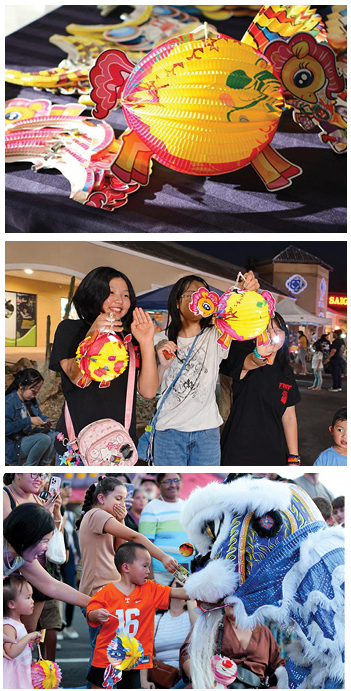
Beneath the full moon at the Saigon Center, our lantern procession fanned out into lateral excursions at the edges, with children peeling away into detour after detour — their attention arrested by the holographic twinkle of Pokémon cards, drawn toward the salt-and-oil perfume of frying potatoes, the pendulous glitter of keychains, and every temptation in between, before they knit themselves back into a line, just as they always had.
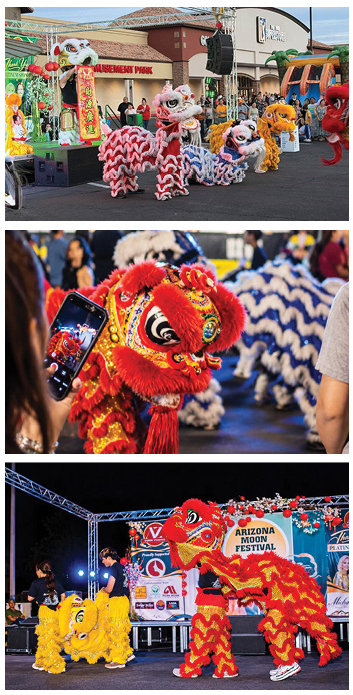
Nothing about our festival resembles the order of a procession, yet from a distance, it looked almost calligraphic, curling against the blunt asphalt of the comically mundane parking lot. A restless luminous stroke of vermilion and gold thickened into bright knots as the children accumulated shoulder to shoulder, attenuating into a filament where someone hurried to recover lost ground, only to wander suddenly beyond its own apparent margins.
Through the cellophane of a star lantern and its floating radiance, I made out the bamboo ribwork visible underneath: a taut, angular skeleton of crossed slats keeping the thin red membrane distended against the dark; turn it edgewise, and its extravagant five-pointed face collapses suddenly into a narrow incandescent seam.
This was Tết Trung Thu in Chandler, Arizona. Tonight people moved obliquely across the white markings of the asphalt, tracing indecisive routes of appetites — Boba cups sweating underneath their sealed lids, the hot oils of Gyoza sending their smell farther than their booths could contain. Among all the food and merchandise, a psychic offered the evening’s most abstract commodity: whatever happened next. What better entertainment exists for the children of Tết Trung Thu?
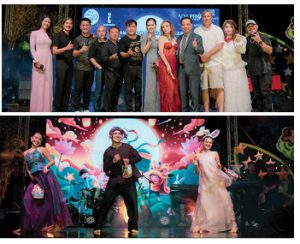
I say this from experience, having returned to the festival every year since I was eight: first as a child wandering toward whichever booth arrested my attention, later as a contestant in the Children’s Contest looking outward from the stage, and now as an MC of that same contest, welcoming another generation into the abundance I once wandered through myself. The beauty of the festival is its instinctive refusal to police a hard perimeter around itself. It is Vietnamese in its stories, its lanterns, its food, but the crowd has always exceeded any single inheritance. The beauty of this festival is the Vietnamese families beside Mexican families, Korean families, white families, children slipping easily among them. The beauty of our festival is the international showcase, sending performers across the stage in garments freighted with traditions far beyond our own. The beauty of my festival is the assortment of booths, and while misunderstood as random, their disorder follows its own generous logic: the festival refuses to prescribe the terms of a child’s delight. (Cultural coherence has never been much of a concern to an eight-year-old!) I loved this festival at four, because there was so much for me to love— the lanterns, the booths, the strange little attractions exerting their competing gravitational pulls! I loved it again at eight, ten, thirteen, the years I had competed, and every year in between, and I love it still, perhaps even more now, with a fresh understanding of what my Vietnamese culture really looks like. It is a culture of acceptance, a culture taking shape from displacement after 1975, refugees arriving carrying a country’s worth of language, food, and memory into places they would learn to call home. A community once finding its place within America now creates a Vietnamese space of its own, allowing other histories to enter without checking them at the door.
Standing onstage, I found myself arriving at an idea I had somehow missed after having taken the festival for granted for so long — that this openness required no weakening, no dilution; the celebration was no less Vietnamese even while enlarging its audience. If anything, its particularity seemed to give the evening a stronger center of gravity, giving all of that miscellany something definite to gather around.
The festival never needed to excavate its center in order to make its margins permeable; it persisted stubbornly rooted in a language, a history, and inherited memory— a culture that was not universally shared, while allowing the edges around them to remain porous.
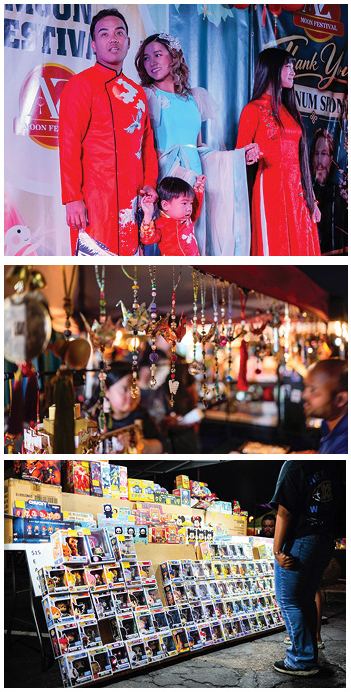
And it was up until then, I had spent years consigning democracy to ballot boxes and election nights. Yet standing there at the lip of the stage, with vermillion-and-gold disorder eddying and reconstituting itself below me, I began to question whether democracy also manifests itself in the informal arrangements of a city, enabling people with irreducibly different inheritances to occupy the same civic life without first being homogenized into it.
Tết Trung Thu offers no illusion of cultural convergence. Its promise is much more enduring, more long-lasting, an embodiment of how people may remain distinct, even unfamiliar to one another, without becoming amorphous; that particular histories may retain their contour, even their tenacity, and yet still exist, in fact being all the better for it.
But the cultural life of a city is far from neutral, being continually composed by the histories permitted to surface within it. And so, during those few hours, even if one crowded parking lot could never account for the people still beyond its reach, Chandler nevertheless bore our imprint, with Vietnamese traveling through microphones across the lot, cultural attire being showcased onstage, and star lanterns passing before families for whom the meanings of those lanterns were entirely new. When I look back now at this event, I see it not as perfect inclusion, nor as us merely being accommodated within the city, but simply as us participating in its authorship, altering, however briefly, what Chandler looked, sounded, and understood itself to contain.
Below I could see the procession having already started to wander once more. One child was intercepted by Pokémon, another by frying potatoes. A star lantern tipped over and collapsed along its narrow incandescent joint. From above the vermilion-and-gold line still appeared almost calligraphic, thickening, thinning, going beyond its edges without losing shape.
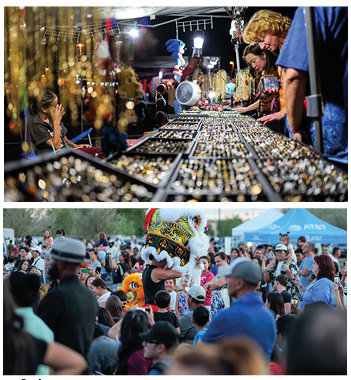
By morning, the asphalt would recover its white rectangles.
Yet for one evening Chandler had been written in a different hand.
Source
Batalova, Jeanne. “Vietnamese Immigrants in the United States.” Migration Policy Institute, 11 Oct. 2023. https://www.migrationpolicy.org/journal/spotlight/vietnamese-immigrants-united-states
Biographical Note
Phuong Nam Nguyen is an 11th-grade student in Arizona who spends much of her time moving between speech tournaments, community events, youth civic programs, and the Vietnamese spaces she grew up in. She founded Generations Together, a youth-led nonprofit centered on intergenerational connection, and is active in speech and debate, civic engagement, and the Vietnamese Community of Arizona. She is most interested in the small moments that reveal something larger: how people inherit culture, how communities make room for one another, and how young people learn to shape the places that shaped them.